Atlantis RAG
Graduation research and a working retrieval prototype for an enterprise collection management platform, combining hybrid search with access control enforced by Atlantis.
Retrieval proposes. Atlantis decides.
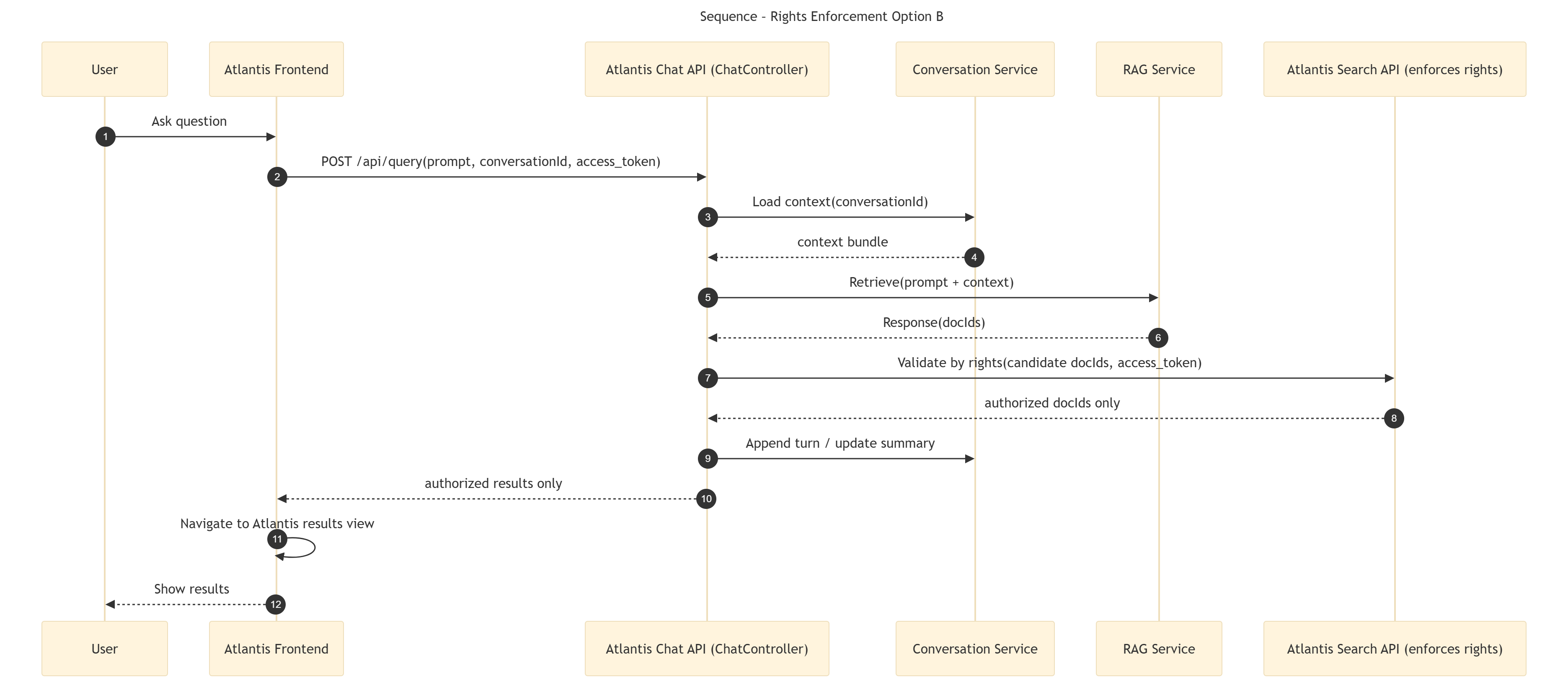
Relevance and permission are separate concerns. The existing Atlantis backend remains responsible for authorization.
Structured intent
The model extracts the topic and supported metadata constraints into tool arguments.
Five prototypes. A clearer boundary.
The experiments are stages of the research, not a single production stack.
Translate intent into API requests
An agent called the existing search API with the user’s token. Sending complete responses to the model exposed more data than intent interpretation needed.
A - Interpret the question · A · API translation
Inspect the research
Explore the engineering decisions and their supporting evidence.
Overview
During my Software Engineering graduation project at DEVENTit, I investigated how to add natural-language search to Atlantis, an enterprise collection management platform. The goal was to help users find collection records through conversational questions while preserving the platform’s existing authentication and authorization rules.
I combined analysis of an unfamiliar enterprise security model with technology research, architecture design, iterative prototyping, and scenario-based evaluation. The delivered work comprised a graduation research report, requirements and architecture documentation, and a working proof of concept for indexing and retrieving collection data.
The central decision was to keep Atlantis responsible for access control. The retrieval service proposes relevant document identifiers; Atlantis checks those candidates against the authenticated user’s rights before returning results to the interface.
Research: Overview. 1 of 10.
Evaluation and observed results
Indexing. The research documents record export, transformation, embedding enrichment, bulk storage, and background batch execution. The indexed collection demonstrates that the flow worked beyond isolated sample records.
Retrieval. Scenario tests show natural-language prompts becoming search terms and structured filters, followed by results displayed in Atlantis. English prompts about war and a mayor also returned relevant collection results, providing examples of cross-language retrieval behavior.
Authorization. The evaluation compares a record appearing for a user with sufficient rights and being absent for a user without those rights. This supports the intended separation between retrieval relevance and permission to view a record.
The evaluation establishes proof-of-concept feasibility. It does not establish a measured relevance improvement, comprehensive tenant-isolation assurance, production latency, or resistance to every adversarial prompt. The reported tests are scenario-based, not an exhaustive security audit or a controlled retrieval benchmark.
- Python
- FastAPI
- Elasticsearch
- LangChain
- Sentence Transformers
- BM25
- Reciprocal Rank Fusion
- Server-Sent Events
- Security / RBAC